Surgical Option Card: Thigh-flap (ALT) phalloplasty with scrotoplasty
Print or save Surgical Option Card:
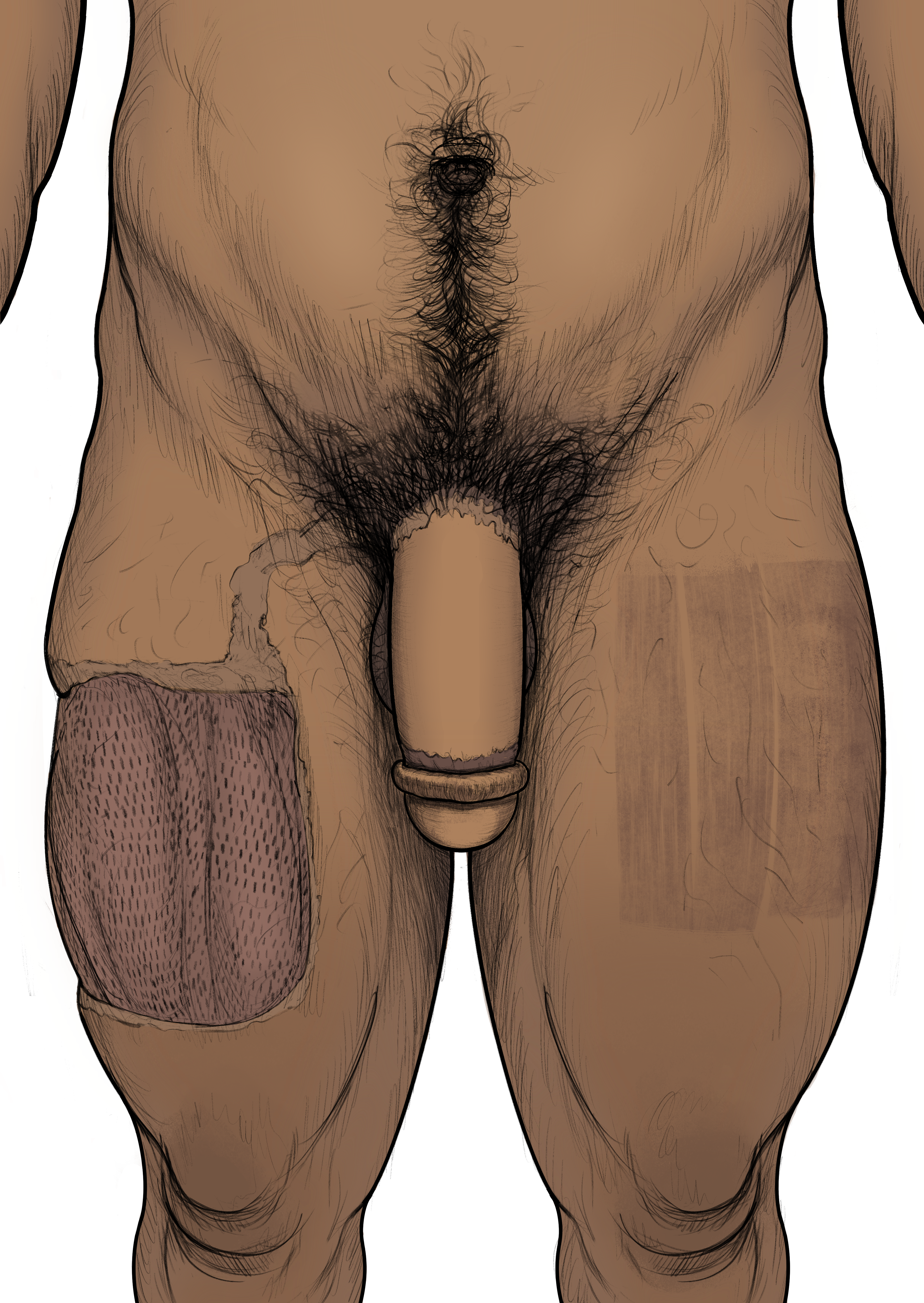
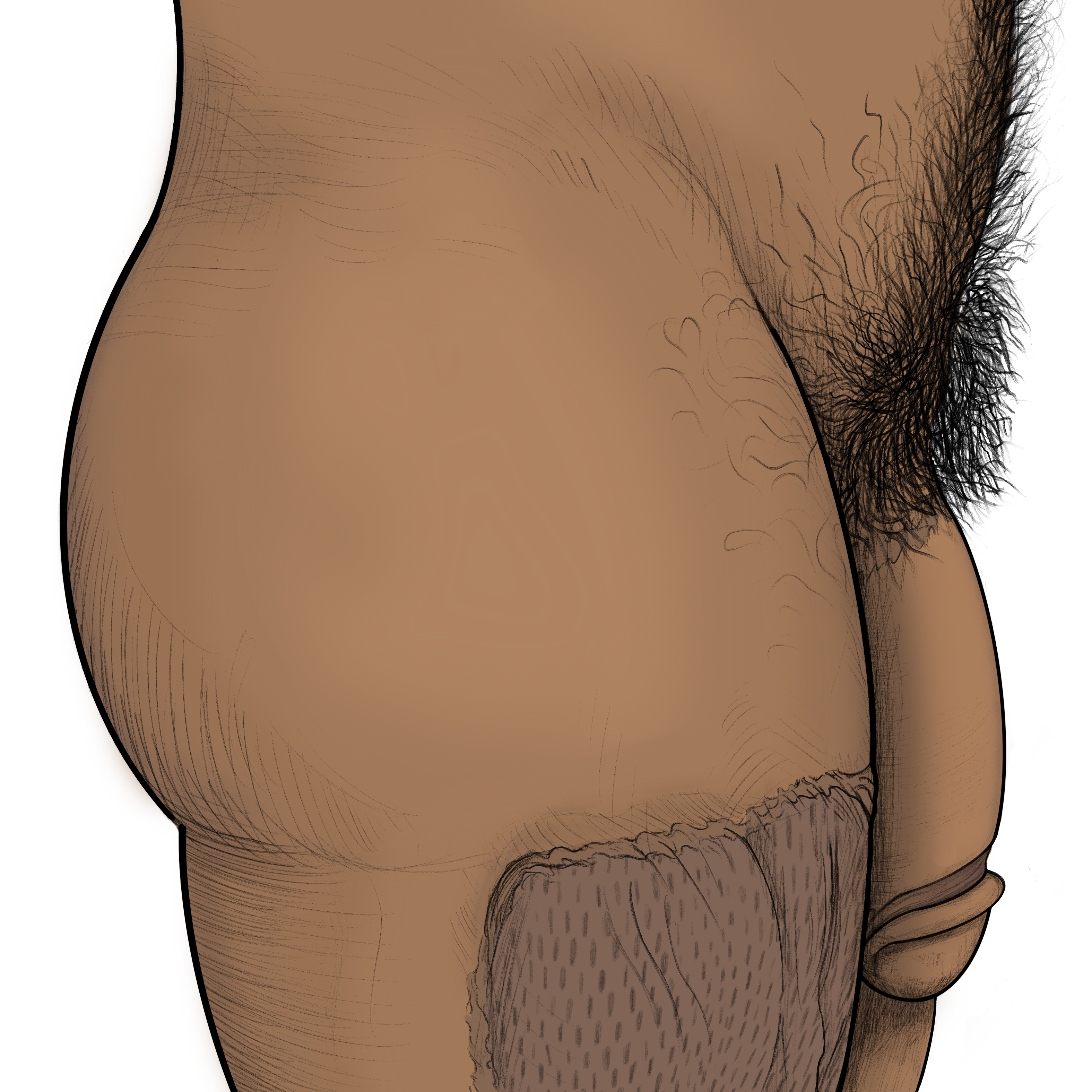
Figure 1
Figure 2
Thigh-flap (ALT) phalloplasty with scrotoplasty
Thigh-flap (ALT) phalloplasty with scrotoplasty, but without closure of the vagina, urethral lengthening, testicular implants, or erectile implant. Glansplasty is optional.
What does this option involve?
- This surgery creates an adult size penis with a larger possible girth and length.
- Your surgeon uses skin, fat, nerves, and blood supply from your thigh to make a penis.
- The thigh flap donor site is covered with a split thickness skin graft from another area on the thigh, or your other thigh.
- Your labia majora will be used to create the scrotum, and your labia minora will be used to cover the area where the labia majora used to be.
How many surgeries are needed?
- This surgery creates a penis in one stage. A second stage may be needed for scrotoplasty and glansplasty.
Will I be able to stand to pee?
- Unless this was already possible with your anatomy, you will still need to sit to pee unless you use a stand-to-pee device.
Will I pee out of the tip of my penis?
- No. You will continue to pee from the same place that you currently pee from.
Urethral lengthening is needed to pee though the tip of your penis.
How long will my penis be?
- The average length of the penis after surgery is 12 cm (4.75 in.).
Will I be able to feel temperature sensation, tactile sensation, and pain sensation in my penis? Can I have an orgasm, or feel erogenous sensation with my penis?
- Many surgeons believe that there is around a 60-70% chance that you may be able to feel some amount of these sensations, but the sensations may not be strong or present in the entire penis.
Can I have an orgasm, and/or feel erogenous sensation with my penis?
- Some people will be able to feel erogenous sensation in their penis.
- While some people can orgasm by stimulating their penis alone, some people still need to stimulate their clitoris in order to orgasm.
- Many surgeons believe that the probability that people will not lose erogenous sensation in their clitoris (whether it is buried or unburied) is higher than 70%.
Will I be able to have an erection?
- No. You would need an internal erectile implant to have an erection.
Will I be able to penetrate a partner during sex?
- Yes, if you use an external erectile device.
Will I be able to receive penetrative intercourse via a vaginal canal during sex?
- Yes, you will still be able to be vaginally penetrated if that is something you are interested in doing.
Will I be able to become pregnant and carry and birth a child via the vaginal canal?
- This may be possible for people if they stop testosterone before attempting to become pregnant.
- However, it is important to talk about your fertility options and goals with your doctor.
- For example, pregnancy may pose a risk to the blood supply that goes to your penis.
Will I have a donor site scar?
- Yes, you will have a scar on your thigh where the flap was taken to create your penis. This scar will be permanent.
- You may also have a scar on your thigh where the split thickness skin graft was taken to cover the thigh donor site. This scar may be permanently visible.
- If you have glansplasty done, the skin on your penis may be rolled up near the glans to form the ridge. You may have another scar on your thigh or abdomen where a skin graft was taken to cover the area on the penis where the skin was moved to create the glans. This scar may be permanently visible.
- You may also have scars on the base of your penis where it is attached to your body, on the underside of your penis, around the glans, in the area below the glans where the skin graft was placed, and along the perineum where the vagina was closed. There may also be a divot there.
Will I have a foreskin?
- You won’t have a foreskin.
- With glansplasty, your penis will look similar to a circumcised penis.
- Without glansplasty, your penis may look similar to an uncircumcised penis; medical tattooing can add details that will aid in this appearance.
What will I need to do before surgery?
- Many surgeons and insurance companies will require that you provide one or more letters from mental health providers as per The World Professional Association for Transgender Health (WPATH)’s Standards of Care (SOC).
Is there a BMI (body mass index) requirement for this surgery?
- Many surgeons have a specific BMI requirement of 35 or below, although it can vary.
- Surgeons will also evaluate patient’s health on a case-by-case basis and may require that any comorbidities correlated with a higher BMI are well-managed to reduce the risk of complications from surgery.
- Some surgeons perform a delayed stage phalloplasty and remove some of the fat from the thigh flap before the penis-creation stage. If the penis has too much girth after phalloplasty, surgeons may use liposuction and tissue excision to remove fat after the penis has been created. The urethra may also be created in a different way than it is with forearm-flap phalloplasty to help reduce girth.
- Despite these options to reduce girth, the many people who have a thicker layer of body fat on their thighs are not good candidates for thigh-flap phalloplasty.
Do I need a hysterectomy or oophorectomy?
- No. You can choose to keep your uterus, Fallopian tubes, cervix, and ovaries if you want to keep them.
- You can also have any of those things removed if you do want a hysterectomy and/or oophorectomy.
Do I need to stop using nicotine before surgery?
- Yes, you will need to stop using nicotine for 8 to 12 weeks before surgery. This includes cigarettes, vapes, gum, patches, wraps and e-cigarettes. You should discuss other substance use with your surgeon before surgery.
Do I need to stop taking hormones before surgery?
- No, most people do not need to stop taking testosterone before surgery. You should discuss your medications with your surgeon to see if any need to be stopped before surgery.
Is hair removal is needed?
- Hair removal is not always medically necessary, but some people choose to have electrolysis and/or laser hair removal done on their thigh before surgery or on their penis and scrotum after surgery for aesthetic or dysphoria reasons. This is sometimes covered by insurance.
- Depending on the amount of hair someone has and whether they are still undergoing changes from testosterone and developing thicker and darker body hair, hair removal can take two or more years.
How long is the hospital stay?
- You may stay in the hospital for 5-6 nights after your penis-creation surgery.
Will I need to stay near the hospital?
- You may need to stay near the hospital for the first 4-6 weeks after the penis-creation surgery.
- You may need to stay near the hospital for 1 week after the scrotoplasty.
Will I need a caretaker when I get home?
- A caregiver can be helpful for the first 1-2 weeks after surgery. Your ability to bend and lift will be limited during your recovery, and you will need assistance with some activities of daily living.
- After the scrotoplasty surgery, you may need a caregiver for 2-3 days.
How long will it take to recover once I’m at home?
- After your penis-creation surgery, you may be able to return to most of your daily activities, including work, after six to eight weeks. Some people with very physically demanding jobs may need longer than eight weeks. If you develop complications, you may need more time off from school or work.
- The amount of time you will need off from work for any subsequent stage will depend on what you have done in that stage and whether you develop complications.
What appointments will I have before surgery and after surgery?
- You will have at least two appointments before surgery, and several post-operative appointments after surgery.
How much does getting surgery cost?
- The cost of surgery depends on your insurance coverage.
Will I need a urethral catheter or a suprapubic catheter?
- After your penis-creation surgery, you will have a Foley urethral catheter in place while you are in the hospital until you are able to walk to the bathroom.
- You may have the catheter removed before you are discharged from the hospital.
- You will not need a suprapubic catheter.
Are donor site complications likely?
- In around 17% of cases, people have complications at the donor site.
What are some possible long-term donor site outcomes?
- Some people experience pain or tightness in their donor site after they are fully healed. Scar massage and steroid injections can sometimes help with this.
What is the risk of urethral stricture or fistula preventing peeing from the tip of penis?
- You will not have a fistula or stricture if you do not have urethral lengthening. You may experience bladder spasms or an infection from the urethral catheter.
What is the risk of developing a wound complication?
- Learn more about wound complications here:
What will wound care be like after surgery?
- Your surgeon will tell you what wound care supplies you need to purchase, if any, and explain how and when to use them. It will take at least 6 weeks until your donor site is fully healed.
What are the chances of losing erogenous sensation?
- It is possible that you will not gain erogenous sensation in your penis.
- It is also possible that the erogenous sensation in your clitoris may be reduced, although this is not common.
- Discuss your options and preferences for clitoral burial with your surgeon before you have surgery.